
Green County Court Records After Arrest
A Green County arrest can create several records. The jail record starts with custody and booking. The court record starts when charges are filed in the Kentucky Court of Justice system. For Green County, the official court page lists the Green County Judicial Center at 200 W. Court Street, Greensburg, and names the Circuit Court Clerk contact numbers for court business. Court records after a jail arrest are checked through the clerk that heard the case or through Kentucky eCourts when the public portal supports the search.
The jail roster and the court case are connected but not identical. The roster may show arresting agency, booking date, initial charge text, bond, warrant number, or hold fields. The prosecutor may later amend, reduce, dismiss, or add charges. For custody and booking details, use Green County jail inmate records. For booking photos, use the jail mugshots page. For filed charges, case status, and dispositions, use court records after an arrest.
The Kentucky Court of Justice Green County page is the best local entry point for court contact details. The captured page shows the official county court landing page used for Green County case and clerk information.
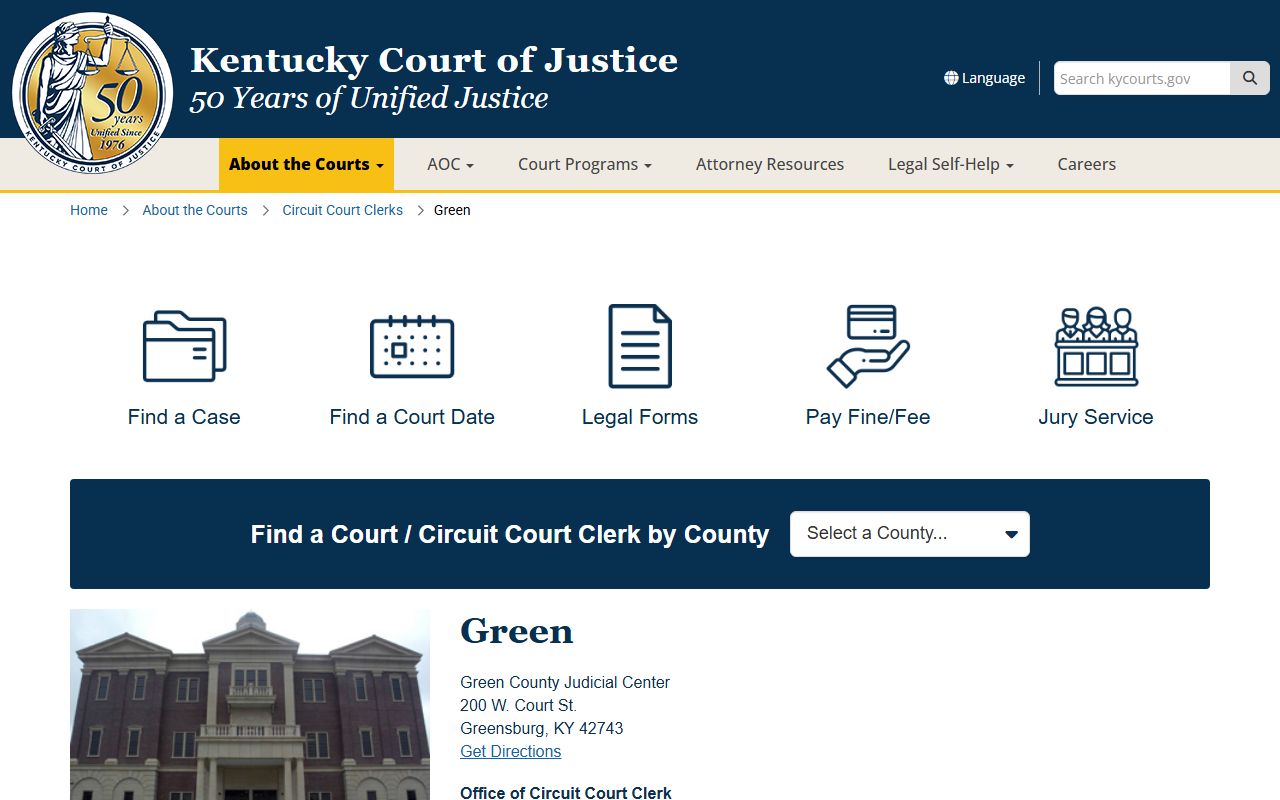
Start with the court that handled the case when a portal result is missing or incomplete.
Search Green County Court Records After Arrest
Kentucky Court of Justice guidance says case-record requests begin with the clerk of the court that heard the case. For Green County arrests, that often means the Green County Circuit Court Clerk or the public eCourts guest portal. The eCourts guest login is an official court case-search route, but access depends on portal terms and available public case data.
- Open the Kentucky eCourts guest portal or the Green County Court of Justice page.
- Search by defendant name if the case number is not known.
- Open the matching criminal case and review charge text, court, dates, and status.
- Compare the filed charge against the jail roster charge if custody is still active.
- Contact the clerk for older files, certified copies, or records not visible online.
The Kentucky eCourts guest login is the online channel documented in the research. The screenshot shows the guest access point for Find a Case.
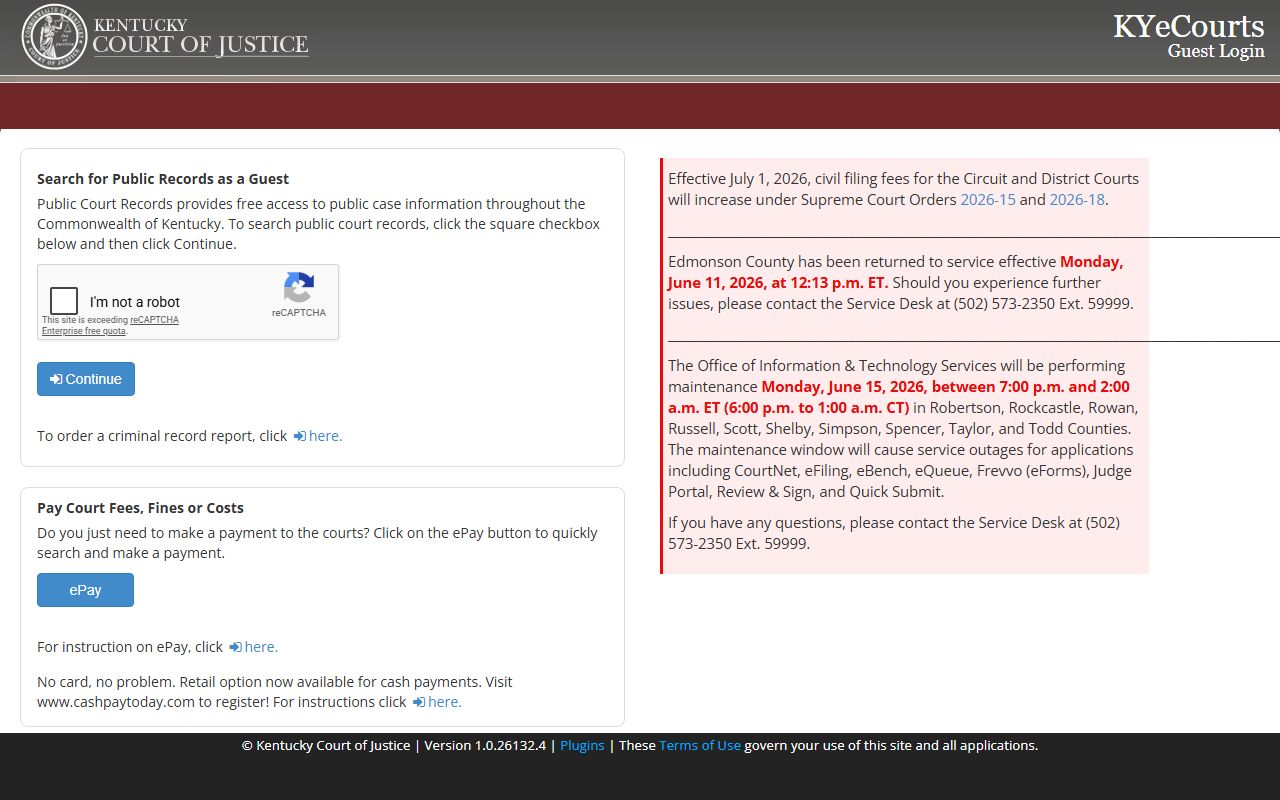
Portal records may not replace a clerk request when a certified record, older file, or sealed-case answer is needed.
Charges Filed After a Green County Arrest
After booking, a prosecutor reviews the police or sheriff allegations and decides what charges move forward. Kentucky uses County Attorneys and Commonwealth's Attorneys rather than a District Attorney title. The Green County official elected page lists County Attorney Russ Goff at 116 South Main Street, Greensburg. Felony prosecution may involve the Commonwealth's Attorney after felony referral or indictment, though a dedicated Green County Commonwealth's Attorney page was not located.
| Document | Who Files or Issues It | What It Means |
|---|---|---|
| Complaint | Officer or prosecutor | Initial charging paper that can start a criminal case. |
| Information | Prosecutor | Formal prosecutor charging document used in many cases. |
| Indictment | Grand jury | Grand-jury charging document, often tied to felony prosecution. |
A booking charge is an allegation used at intake. A court charge is the filed accusation in the case. A conviction happens only after a plea, trial verdict, or other final criminal disposition.
Green County Charge Status Records
Charge status can change as a case moves through court. A charge may be pending at arraignment, amended by agreement or court order, dismissed, merged into another count, or resolved by plea or trial. That is why court records after a jail arrest should be checked separately from the roster. The jail record answers where the person is held. The court case answers what was filed and where the case stands.
| Status | What It Means |
|---|---|
| Pending | The charge remains open and has not reached final disposition. |
| Amended | The charge text, level, or count changed after filing. |
| Reduced | The charge moved to a lower level or lesser offense. |
| Dismissed | The charge was dropped by court action and did not produce a conviction. |
| Convicted | A plea or verdict resulted in a finding of guilt. |
Bond Records After Arrest
Bond can appear in both jail and court records. Taylor County Detention Center says bonds can be paid at the detention center at any time, with exact cash required for most cash payments. Cash bonds over $10,000 and property bonds must be handled through the Circuit or County Clerk depending on the case. A no-bond hold or detainer can keep a person in custody even when one charge appears bondable.
| Bond or Hold | How It Works |
|---|---|
| Cash bond | Money posted to secure future court appearance. |
| Surety bond | Bond backed by a qualifying surety or bonding process. |
| PR / ROR | Release on personal recognizance, based on a promise to appear. |
| No-bond hold | Custody status that cannot be cleared by posting ordinary bond. |
| Detainer | A hold from another agency or jurisdiction. |
Warrants and Green County Arrest Records
No official Green County active-warrant roster or Greensburg Police warrant database was located. The Greensburg Police Department and E911 page does list Chief Josh Judd, the police phone line, a tip line for reporting a crime or wanted person, and E911 non-emergency contact. The Green County Sheriff's phone is the local sheriff contact for agency guidance. Once a warrant is served and the person is booked, Taylor JailTracker may show warrant number, case number, bond, hold type, or charge status if those fields are enabled.
- Arrest warrant
- Authorizes arrest on a criminal allegation.
- Bench warrant
- Issued by a judge, often for failure to appear or violation of a court order.
- Search warrant
- Authorizes a search, not a public custody lookup.
- Fugitive hold
- A hold tied to another agency or jurisdiction after booking.
Charges vs Convictions
A Green County jail arrest does not equal a conviction. A charge is an accusation that appears in a jail or court record. A conviction is the result of a guilty plea, trial verdict, or other court finding. Public users should avoid treating booking charges as final outcomes, especially soon after arrest when prosecutor review is still underway.
| Charge | Conviction | |
|---|---|---|
| Stage | Accusation after arrest or filing | Final court outcome after plea or verdict |
| Proof | Probable cause or prosecutor filing | Guilt established by legal process |
| Where checked | Jail roster and court case | Court disposition or criminal-history report |
Sealed and Expunged Court Records
Kentucky expungement and sealing issues depend on the exact case outcome and statute. The Kentucky State Police expungement page links felony expungement to KRS 431.073 and the Kentucky Court of Justice process. Expungement is not the same as asking a website to remove a stale booking page. It is a court process that can change what appears in public court and criminal-history records when the case is eligible.
| Sealed | Expunged | |
|---|---|---|
| Public view | Hidden from most public access | Treated as removed under the court order |
| Process | Requires case-specific court action | Requires statutory eligibility and court action |
| Kentucky source | Court clerk or eCourts guidance | KRS 431.073 for eligible felony convictions |
Background Check Limits
The Kentucky Court of Justice background-check page describes public criminal-record reports and the AOC Records Unit. That is a different use from casual court lookup after a jail arrest. For employment, tenant screening, credit, insurance, or other FCRA-covered uses, use proper consumer-reporting procedures and authorized sources. A general public custody or court page is not a consumer report.
Important: Do not use jail or court lookup pages for FCRA-covered screening decisions.
Restricted Green County Court Records
Some records may be redacted, withheld, sealed, or unavailable online. Juvenile matters, sealed cases, active investigative material, protected personal information, and certain law-enforcement records can be restricted. KRS 17.150 and the Kentucky Open Records Act framework both matter when a person asks for arrest or investigative records. If a clerk or agency denies a request, the response should identify the legal basis or route for the next step.